English
 Русский
2026.04.28. The Divine Liturgy. Discussions with Metropolitan Jonah (Paffhausen). Part 5
2026.04.28. The Divine Liturgy. Discussions with Metropolitan Jonah (Paffhausen). Part 5
Subscribe: https://youtube.com/StJohnDC?sub_confirmation=1
The Divine Liturgy, Part 5
The Temple
Talk by Metropolitan Jonah
April 28, 2026
Summary:
1 The priesthood is necessary for the Divine Liturgy, its nature and its meaning. The priest and bishop are the “stewards of the mysteries of God,” consecrated by the Holy Spirit to sanctify the faithful through the Holy Mysteries. The bishop/hierarch is the high priest, who has the fullness of the apostolic deposit and passes it on through ordination to the priests. Deacons are ordained by the bishop to assist in the Eucharist and other mysteries.
2 Typology is at the heart of the sacramental idea: the consecration of created matter including men as bearers of Divine Grace/energy. The historical type prefigures the eschatological archetype, and the contemporary antitype makes present the archetype by the grace of the Holy Spirit. The sacraments (antitypes) convey the grace of God to the faithful, from the eternal Archetype, the Lord Jesus Christ.
3 The bishop or priest, when presiding at the Eucharist, is the type of God (St Ignatius) or of Jesus Christ our true High Priest, from whom we receive the Spirit, and which transforms the Bread and Wine into the Body and Blood of Christ. The Spirit acts through the bishop or priest who fulfills the antitype by union/synergy with the Archetype. The sacraments make eternity present. God’s actions/energy unite and lead us up to contemplate and participate in the eternal actions of God.
4 The Temple is the material antitype of the eternal Temple not made by hands, and the divine actions of the holy mysteries are participation in the heavenly Liturgy at the Throne of God in eternity. The Archetypal eternal Temple is the Holy of Holies of Heaven, where God is enthroned, and the Lord Jesus Christ is co-enthroned at His Right Hand, surrounded by the cherubim/four Living Creatures, the 24 elders/presbyters enthroned around them.
5 The Orthodox Christian temple is the fulfillment of the OT temple type, fulfilled by Christ and the New Covenant. Its priesthood is the fulfillment of the types of OT priesthoods, but especially of Melchisedek, whose priesthood was fulfilled in Christ, as a type of eternal priesthood, with neither beginning nor end.
6 The Tabernacle and Temple of Solomon had 3 sections: the outer court of the Gentiles; the court of the priests; and the Holy of Holies. The altar of sacrifice was in the second part, with a huge basin of water. Before the doors of the Holy of Holies was the table of the Showbread, and the lampstand/menorah. Inside the Holy of Holies was the Ark of the Covenant which contained the tablets of the Law, the manna, Aaron’s rod that budded, all covered with the Mercy Seat. Also in the most holy place was an altar of incense, and two giant cherubim between which was the Throne of the King.
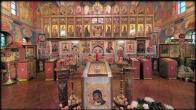
7 The Orthodox temple has 3 analogous sections: the narthex, the nave and the Altar. In the Altar area: the Throne (the Ark) in the center, with the Book of the Gospels (tablets of the Law), the reserved Eucharist (the manna), the Cross (Aaron’s rod); the 7-branch candlestick (menorah); the Bishop’s Throne (King’s Throne) in the high place; and the fans with cherubim. Instead of an altar of incense is the censer.
8 The central theme of the Liturgy is the entrance into Heaven, into the altar, of the celebrant with the angels (those serving). First is the entrance with the Gospel. After the first Trisagion, the bishop goes to the high place and is seated on his throne, surrounded by the presbyters. Then the hearing of the Word of God, the Epistle and Gospel. There is a second entrance, with the Gifts to be offered. The choir sings the Entrance Hymn, “Let us who mystically represent (are mystical icons of) the cherubim, and sing the thrice-holy hymn to the life-creating Trinity, now lay aside all earthly cares.” The gifts are presented to the bishop and offered in the Anaphora. The Bishop is the antitype of Christ the Great High Priest “who offers and is offered,” and the service proceeds towards the consecration, the offering.
9 The temple is designed to facilitate the movements of the Liturgy. A church building should be timeless, not a period piece reflecting a particular modern architectural fad. The experience should be that of entrance into the timelessness of Heaven. Even if the architecture does not reflect this, the iconography and the furnishings of the temple should.
10 The Christian Temple is consecrated to be a dwelling place of the glory of God, and assigned an angel to be there forever. An Orthodox temple is set apart by the perceptible Presence of grace, of the Presence of God. There is a peace to an Orthodox temple unlike non-Orthodox churches that is beyond aesthetics and beyond simple silence.
11 When a temple is consecrated, the bishop focuses on the consecration of the Holy Table. It thus becomes the place where the Mysteries are celebrated, and an outpost of heaven.
ПРИХОДСКАЯ ЖИЗНЬ
Адрес нашего Собора
Пожертвовать